Show Opens October 30th: Notable French Painters of the 19th & 20th Centuries
Click Here


RAOUL ARUS
(1848-1921
)

"UN DIMANCHE À LA CAMPAGNE"
Oil on Canvas, Signed Lower Right, Dated (1898)
Painting Size 15" x 24"
Framed Size 22 1/2" x 31 3/8"

Inquire about price.
 

Known for his landscapes and military subjects, Raoul Arus began his studies with Isidore Pils at the École des Beaux-Arts in Marseille.

From 1874 until his death, he exhibited at the Salon des Artistes Français. He received a silver medal in 1900, and was named Legion of Honor in 1906.

His landscapes, animated and with narrative quality, often reflect his youth in the Midi.

Arus documented military events in well-known paintings such as Siége de Paris; Aprés la Lutte; La Quarante-Cinquiéme Demi-Brigade; Iéna; Wagram; and La Retraite Allemande. The Museum of Bayeux has En Marche in its permanent collection.

Of special interest to Americans is that the British surrender at Yorktown was a subject painted by Raoul Arus. National Panorama of the Surrender of Yorktown is a 16-page book authored and illustrated by him, published around 1899. It is the permanent collection of the New York Public Library.


Marcel Gaston Belle
(1871-1948)


“Le Bateau Lavoir á Paris”
Oil on canvas, Signed and dated L/L
Painting Size: 10 ½ x 13 ¾”
Framed size:  17 ⅛ x 20 ¼”


Marcel Gaston Belle was born on 17th February, 1871.  He came from a long line of distinguished painters, notably Alexis-Simon Belle (1674-1734), painter to the courts of France, Poland, and that of James II of England. 

Even from his childhood in Frankfurt, where his father was French Consul General, and later in Constantinople and Athens, Marcel Belle sketched the surrounding countryside.  In Paris, having decided to devote his life to painting, he frequented the Grande Chaumière and the Académie Julian where he was befriended by Henri Martin and became his pupil.

Belle’s work is divided into three distinct periods: firstly, a Neo-Impressionist pointillist technique influenced by Seurat and Signac which he adopted for his early landscapes of the Ile de France; secondly, a Divisionist pointillist technique, influenced by Henri Martin and apparent in his paintings of Finistère and the Seine valley, and thirdly, a Synthesist technique.

In 1920 Belle exhibited at the Salon d’Automne; between 1921 and 1928 he exhibited also at the Cercle Volney, and between 1926 and 1939 at the Salon des Indépendants.  From 1921 to 1945 he belonged to the Salon Nationale des Beaux-Arts, becoming an associate member in 1938.  In the last 30 years of his life Belle was honored with numerous prizes and medals as well as with State commissions, and a posthumous exhibition of his work was held at the salon of 1949.


Victor Jean Baptiste Barthélemy Binet
(French, 1849 – 1924)

PAYSANNES SUR LE CHEMIN FLEURÉ
(PEASANTS ON THE FLOWERED PATH)
Oil on canvas, signed L/R
Canvas (12M): 13 ¾ x 24”
Framed: 23 ½ x 33 ½”


SOLD


The Artist is: Victor Jean Baptiste Barthélemy Binet (French, 1849 – 1924) Victor Binet was a landscape artist from Rouen who learned the craft of landscape painting from Troyon, who was one of the original leaders of the Barbizon movement. In 1878 Binet began exhibiting at the Salon de Paris, achieved hors-concours in 1886 and won a gold medal in 1889. In 1886 Binet was the French representative to the Royal Academy in London, and in 1900 he became an Officer of the Legion of Honor. Many of Binet’s paintings were done in the vicinity of Saint-Aubin-sur-Quillebeuf, where he died at 75.


click to enlarge
ANDRÉ DUNOYER DE SEGONZAC
(French, 1884-1974)

PRINTEMPS

Oil on canvas, Signed U/R
Canvas: 29 ½ x 36”
Framed: 34 ½ x 41”


Inquire about price.
   
One of the most important and accomplished of the post-Impressionists, de Segonzac had a brilliant career until the very end of his life at age 90.

He cited 1906 as the start of his artistic career: his first Salon d’Automne submission was in 1908, and he exhibited at the Salon des Independants in 1909. For the next several years he exhibited regularly at both.

He was a member of the group known as the section d’or, which in the 1910s stressed geometric aspects in Cubism. His painting style, anchored by excellent draftsmanship skills, became more lyrical and naturalistic after 1920. His watercolors, lithographs and etchings include landscapes, dancers, figures and still lifes, all executed with great spontaneity and elegance.

He was one of the modernists included in the Armory Show that opened in New York in 1913, with subsequent showings in Boston and Chicago. His first solo exhibition followed in 1914 at Galerie Levesque in Paris. Drafted for military service shortly thereafter, he published and exhibited a number of war drawings and by the war’s end earned the Croix de Geurre. De Segonzac began etching in 1919 in order to illustrate “The Wooden Crosses” by R. Dorgelès (published in 1921) and by the end of his life had produced some 1600 plates.

The gossamer quality of his etchings stands in contrast to the thickly painted surfaces and subdued colors of his oil paintings, which reflect his admiration for Courbet and Cezanne. He is well-represented in museums in France, the UK, the United States and other countries, including:

Louvre, Paris; Tate Gallery, London; Museum of Modern Art, New York; Art Institute of Chicago; Fine Arts Museum, San Francisco; Courtauld Institute (UK); Fitswilliam Museum, University of Cambridge (UK); Ashmolean Museum, University of Oxford (UK).


PIERRE DUMONT
(1884-1936)


"NOTRE DAME DE PARIS "
Oil on Canvas, Signed Lower Right
Painting Size 28 3/4 " x 36 1/4"
Framed Size 37 1/2" x 44 1/2"

Inquire about price.


One of the most influential post-Impressionist artists, Pierre Dumont was born in Paris on March 29, 1884. Against the wishes of his father, Dumont enrolled at the Lycée Corneille; it was there he met Robert Antoine Pinchon and Marcel Duchamp who became lifelong friends.

In 1906, at the age of 22, Dumont held his first one man exhibition at Galerie Legrip, a Rouen dealer who promoted Normandy painters. Dumont's paintings confirmed his fiery temperament as a colorist and his departure from the influence of Impressionism. When the Fauve movement ran out of steam, Dumont took it upon himself to create a parallel salon. He united a "Group of XXX" with the first exhibition held at Galerie Legrip. Two years later this group expanded into the Sociéte de Peintures Modernes. Included were some of the most exciting artists of the time. Even Paris-based painters such as Utrillo, Vlaminck, Luce and Gillamin sent their works to Rouen for these exhibitions.

From 1914 - 1924 Dumont achieved great success with his paintings of street scenes in Monmartre, Notre Dame cathedral and the bridges of Paris. But in 1927 he suffered the first of many "cerebral attacks" which endured intermittently for ten years.

In February 1931, he was invited by Armand Drouant to hold an exhibition at 35 Rue de Seine. This was the last exhibition held while the artist was alive. His eyesight dimmed and his right hand paralyzed, Dumont painted with his left hand during his final years. He died in a Paris hospital in 1936 at the age of 52.
   
 
JAC MARTIN-FERRIÈRES
(1893-1972)


"Paris - Pont Marie" - 1932
Oil on Canvas, Signed Lower Right
Painting Size 28 1/2" x 23 1/2"
Framed Size 39" x 35"

Inquire about price.


JAC MARTIN-FERRIÈRES
(1893-1972)


"View From My Window" - 1926
Oil on Canvas, Signed Upper Right
Painting Size 25 1/2" x 31 7/8"
Framed Size 37" x 43"

Inquire about price.
 

Son of renown impressionist Henri Martin, Jac Martin-Ferrières also studied with Mormon and Ernest Laurent. He began as a Pointillist painter, but by the mid-1920s he changed to a broader linear framework and broad color areas, with more realistic landscapes. From 1928 - 1955 he received numerous commissions for large decorative works, among the best known is the series of frescoes for the Church of St. Christophe de Javel in Paris. One of his paintings, The Seine in Winter (dated 1921) is in the Holiday Collection of post-Impressionist painters now owned by the Indianapolis Museum of Art in the United States.

In the 1920 Paris Salon he received an Honorable Mention, and in 1923 in the same Salon his painting Le Christ was awarded the Silver Medal, and afterward was purchased by the French State. In 1924, Le Boeuf, won him a traveling grant which enabled him to discover Italy. In 1925 he was awarded the Prix National for his important composition Le Peintre. In 1928 his remarkable Marche d'Assissi was awarded both the Gold Medal of the Paris Salon and the Prix Legay-Lebrun and was then purchased by the City of Paris. In 1937 he won the Gold Medal at the Exposition Universelle, and in 1939 he had a large retrospective exhibition in Paris consisting of more than one hundred and fifty canvases. In addition to the honors and awards received in the Salons, Martin-Ferrières was honored by his country. He was made an Officer of the Legion of Honor in 1956, having previously been named a Chevalier of the Legion in 1937.


ACHILLE LAUGÉ
(1861-1944)


"VASE OF ROSES"
Oil on Canvas, Signed Lower Right
Painting Size 28 3/4" x 36 1/4"
Framed Size 38 3/4" x 46 1/4"

Inquire about price.
 

Achille Laugé studied first in Toulouse and then at the École des Beaux-Arts in Paris, where he took instruction from Cabanel and J.P. Laurens, he met Aristide Maillol and Antoine Bourdelle(whom Laugé had known in Toulouse), and the three formed a lasting friendship.

Laugé exhibited at the Salon des Indépendants in 1894, with other notable Impressionists and was subsequently given a series of one man shows. Early Achilles Astro exhibited his work in 1907 with the eminent critic Gustave Geffory writing the preface for the catalogue. He was given exhibitions by Alvin-Beaumont in 1911; Nunes et Fiquet in 1919; Bernheim-Jeune in 1923; organizations in Toulouse and Perpignan in 1926; Georges Petit in 1927; Galerie de Renaissance in 1929; and Rene Zivy in 1930.

Today, Laugé is one of the most enduring and collectable Neo-Impressionist painters with works in major museums and collections throughout the world, including: Carcassonne; Musée de Limous; Musée Nationale d'Art Moderne; Musée de Agustins; Musée d'Orsay (Paris); The Kaplan Gallery (London); Genéve; Grenoble; Toulouse; Montauban; Limoux; Morlaix; Montpellier; Perpignan; and The Guggenheim (New York).


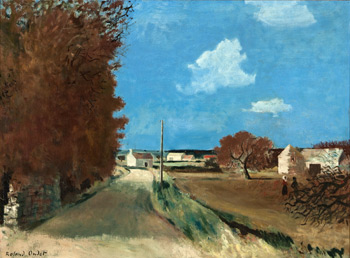
ROLAND OUDOT
(1897-1981
)

"LA CAMPAGNE, APRES MIDI"
Oil on Canvas, Signed Lower Right
Painting Size 28 3/4" x 39 3/8"
Framed Size 38 3/4" x 49 3/8"
 

Inquire about price.


Roland Oudot is an important member of the group known as "Artists of Poetic Reality." This term, describing painters in France between the two World Wars, includes Oudot and his friends, Legueult and Brianchon. They sought the beauty in the real, as a departure from the stylistic Impressionist and post-Impressionist pioneers that came before them.

Oudot studied at the École Nationale des Arts Décoratifs in Paris from 1915 - 1918. Then followed an influential period when he worked with Leon Bakst, head painter for the Russion Ballet. Oudot was given assignments for murals, scenic design and costumes. His involvement with the ballet led to the world of interior decorating, where he designed fabric and furniture for the firm of Sue and Mare.

In 1918, he returned to the École Nationale des Arts Décoratifs and the atelier of Eugéne Morand. Here he studied paintings by Marquet, Matisse and Duffrenoy while he prepared for his first exhibition, the 1919 Salon d'Automne.

By 1925, he was a member of the Committee for the Salon des Tuilleries where his paintings were shown. From then on, the artist was sought by collectors, and for fifty years his works were frequently shown in galleries in Paris, Brussels, New York, Pittsburgh, Sydney, London, Venice, and others throughout France and Switzerland.

He is represented in several museums in France: Musée d'Art Moderne and Cabinet des Étampes in Paris; Musée des Beaux-Arts in Nantes; and in Albi, Bagnols-sur-céze, Cambrai, Grenoble, and Cérés.


EDMOND PETITJEAN
(1844-1925)

Les Lavandières á Talmont (Vendée)
Oil on canvas, signed L/R
Painting size: 18 x 25 ½"
Framed size: 28 x 35 ½"

Inquire about price.


EDMOND PETITJEAN
(1844-1925)

Moret Paysage Seine et Marne (1892)
The Hunters
Oil on canvas, signed L/L
Painting Size: 19 x 27
Framed size: 25 x 32

  
SOLD


EDMOND PETITJEAN
(1844-1925)


"LE HAVRE"
Oil on Canvas, Signed Lower Right
Painting Size 17 1/2" x 25 1/2 "
Framed Size 30" x 38"

SOLD


Petitjean is one of the most accomplished and beloved painters of his era. His father, a lawyer, did not allow him to study art until he had completed his courses at the Faculty of Law at Nancy. From that moment, he abandoned law and was able to devote himself entirely to his artistic career. Success followed swiftly; his work was well-received at the exhibition of the Lorraine Society of the Friends of Art and then, in 1873, he made a brilliant début at the Salon in Paris.

He was awarded an honorable mention in 1881; a bronze medal in 1884; hors concours and a silver medal in 1885; a silver medal in 1889 at the Exposition Universelle; the Légion d'Honneur in 1892, and gold medal at the Exposition Universelle of 1900. He was a member of the jury and of the Committee of the Artistes Français for many years.

Petitjean is perhaps best known for his depiction of the countryside and villages of Lorraine and Vendée. He did however, find inspiration further afield; in the harbours of Le Havre, Dunkerque, les Sables d'Olonne, Dieppe, Rotterdam, Bordeaux and the neighboring coastline.

His work, highly regarded during his lifetime, has continued to gain in popularity. Petitjean's paintings can be found in many important French museums, including Musée d'Orsay and in numerous private collections in America, England and France.
   
 
GEORGES PICARD
(1857-1945)


"LE PRINTEMP"
Oil on Canvas, Signed Lower Left
Painting Size 79" x 64"
Framed Size 85" x 70"

Inquire about price.
 

The hand of Georges Picard graced many buildings throughout Paris at the turn of the Century in the form of a plethora of commissioned portraits and public murals. His important works include the French Embassy at Vienna, the Petit-Palais in Paris, the foyer ceiling of the Opera House in Lille, and a significant commission of the ceiling at the Hotel de Ville in Paris. His two murals, Le Printemps and L'Automne, painted in 1898 for the Grand Casino in Monte Carlo, exemplify the Belle Epoque era, and have endured to the present.

Picard exhibited his work at the Salon des Artistes Français in Paris from 1877 - 1924, and was a regular exhibitor at the Salon de la Société Nationale des Beaux-Arts, of which he was treasurer. He died at age 85 in 1942 during his deportation to the concentration camp of Struthof, France.

Picard's model for Le Printemps was Marie Krysinska, the Symbolist poet. Krysinska, a novelist, essayist and composer, was a favorite muse of Picard and was at the center of the bohemian lifestyle of artists and writers of Montmartre. As well as being a writer published in journals central to the avant-garde such as Le Chat Noir, Krysinska was the accompanist supplying (illegal) live music at the infamous Chat Noir theatre during its brief life.
   
 
ALPHONSE-LEON QUIZET
(1885-1955)


"Rue à Menilmontant"
Oil on Canvas, Signed Lower Right
Canvas:  18 1/8 x 21 7/8"
Framed:  24 1/2 x 28"
   
 
ALPHONSE-LEON QUIZET
(1885-1955)


"Vue de Paris"
Oil on Panel, Signed Lower Right
Canvas:  19 11/16 x 24"
Framed:  26 1/2 x 31"


APHONSE-LEON QUIZET
(1885-1955)


"Rue à Belleville"
Oil on Canvas, Signed Lower Right
Painting Size 28 3/4" x 36 1/4"
Framed Size 38 3/4" x 46 1/4"

Inquire about price.
   
 
Quizet's spontaneous, immediately recognizable style of painting perfectly conveys the rich character of bohemian Montmartre and Paris in the years leading up to the war. He apprenticed as a young man with the architectural firm that built the Petit Palais for the 1900 Paris Exposition. This allowed him to follow courses in architecture at the École des Beaux-Arts before leaving to pursuit his love of painting full time. Even as a self-trained artist, Quizet achieved significant recognition during his lifetime for his contributions to the Modernist Movement. Today his work is highly collectible for its distinctive style and the charm of its naïve quality.

While painting the colorful streets of Montmartre Quizet met Utrillo, who became his protégé. He taught Utrillo how to make watercolors, and from a cabin in Montmartre the two painters sold their first paintings together. In 1914, Quizet exhibited at the Salon de la Société Nationale des Beaux-Arts and then served four years in the Army during World War I. Returning to painting after the war, he painted Montmartre and the Paris suburbs for the remainder of his life.

He was made a member of the Salon d'Automne in 1926 and was named Chevalier de la Légion d'Honneur in 1931. Between 1907 and 1955, his work was exhibited the Salon des Indépendants, the Salon Paris Moderne and the Salon des Tuilleries, as well as in Sweden, Norway and Japan. In 1931, Quizet was awarded the Silver Medal at the International Exposition in Paris.

Quizet is represented in the Musée Nationale d'Art Moderne, the Petit Palais, the Musée des Beaux-Arts and the Musée du Luxembourg; also at museums in Copenhagen, Saint-Etienne, Le Havre, Grenoble and Philadelphia.